
Chekia Pet Lovers Pages
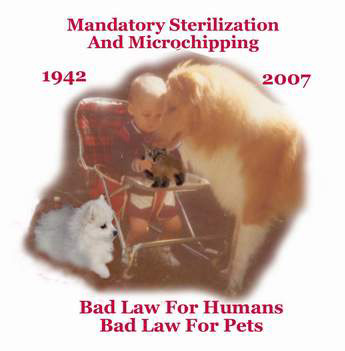
Mandatory Sterilization
June 1, 2007
Re: AB 1634, "CA Healthy Pets Act"
Dear President Faoro and the CVMA Board of Governors,
As a past president of the California Veterinary Medical Association, founder of the California Council of Companion Animal Advocates that sponsored biannual Pet Overpopulation Symposia (now the Animal Care Conference), member of the American Veterinary Medical Association Animal Welfare Committee and the National Council on Pet Population Study and Policy, author of the CVMA and AVMA positions on early spay/neuter, past chairman of the Orange County Animal Shelter Advisory Board, and recipient of the Hill's Animal Welfare and Humane Ethics Award as well as being selected as an AAHA Regional Practitioner of the Year, I have devoted my professional life to trying to understand the many factors that contribute to the continuing problem of animal
relinquishment and euthanasia. I, like most veterinarians, believe that spay/neuter is one of the most important parts of the solution to this national disgrace. Unfortunately, this
divisive legislation will not help and may aggravate the
situation for the following reasons:
Most veterinarians are very conservative about government incursion into their private lives and businesses. It is naïve to invite the legislature into professional decision making.
If they can tell us that we must perform a procedure then they can tell us we can not perform a procedure.
It is inappropriate to mandate a controversial and possibly life threatening surgical procedure. As CVMA has argued in the past, decisions of this magnitude should be made after consultation between the owner and their veterinarian.
As has been published in our journals, not all animals benefit from prepubertal gonadectomy before four months of age. Growth-related problems, urinary incontinence, and behavioral problems have all been reported in higher numbers in animals neutered at such an early age.
It seems inappropriate for a profession to legislate a
procedure that only they can provide.
We all know that we lose money on spay/neuter procedures. However, several legislators see our defense of declawing
and requirement for spay/neuter as nothing more than protecting our "turf" and stimulating income and several dog breeders wondered what would keep spay/neuter prices from going up. We must remember that "perception is reality." Our public image could be seriously damaged if there is exploitation of this unintended opportunity.
The number of animals being euthanized in California shelters has dropped steadily for more than two decades despite the continuous population increase in families with pets. Importantly, the numbers continue to drop faster in shelters that are in jurisdictions that do not have mandatory spay/neuter. The majority of animals euthanized (approximately 60-70 percent in most shelters)
are unowned or unwanted, stray and feral cats. This bill will
not impact this population in any way. There are so few puppies and small dogs in many shelters that they "import" them from other shelters in California, other states and/or foreign countries.
A large percentage of the dogs counted as euthanized are DOA, old, ill, injured, or behaviorally unacceptable. The actual numbers of these animals are unknown due to
incomplete record keeping by the sheltering community.
The majority of dogs euthanized are medium to large mixed breed individuals (many of them pit bull crosses) belonging to irresponsible owners who are hard to identify and who
will never comply with this law and are noncompliant with many other community laws. The number of young, healthy, well socialized, adoptable animals euthanized is much
smaller than the humane and sheltering community has claimed.
The number of animals euthanized continues to decline each year and varies greatly from area to area within the state.
Why do we need a coercive, punitive and intrusive "broad
brush" state law, when this is clearly a local issue?
As it is agreed that breeders of pure bred dogs and cats are relatively small contributors to the shelter euthanasia
numbers, why are they being required to fund the implementation of this law with fees (often quoted between $100 and $200 per year) to simply own an intact animal that may never be bred? Owners of intact animals are already paying a differential licensing fee. Why impose increased taxation on this law abiding community?
It is elitist to only allow pure bred dogs an exemption. We all acknowledge that many of the greatest family pets are mixed breeds. Surely, it is not anyone's desire that we only
have pure bred dogs.
If passed this law will be very unfair to the economically disadvantaged. They are, as a community, poorly educated about pet population control, often culturally averse to
neutering their pets, have the least ability to afford this
surgery, have little access to low cost clinics in most communities and often do not have transportation.
Although this community contributes disproportionately to
the numbers of animals impounded, I don't think there is any political will to deprive them of their pets. In order to have the desired effect, the law would require fines, sterilization at the owner's or the public's expense, or impoundment. No one wants to deny these families the benefits of animal
companionship. And yet, if we fail to address this segment of society; how will this bill reduce shelter euthanasia?
If this bill is passed, it will fail to solve the euthanasia numbers because animal relinquishment is not a problem of too many dogs and cats but one of too few responsible owners. The steady decrease in animals being euthanized in shelters can be accelerated through cooperative effort among veterinarians, animal control agencies, humane activists and dog and cat breed clubs encouraging responsible ownership through enforcing regulations already in place, gathering more useful information in the shelters, designing more effective and better targeted educational materials and delivery systems, differential licensing fees, vaccinating and licensing cats, encouraging owners to keep cats indoors, encouraging spay/neuter of cats allowed outside, microchipping, and providing mobile low cost spay/neuter.
Even if it was possible to "turn of the faucet, "as
Assemblyman Levine likes to say; there would be little reduction in the cost of shelter operation. As hospital owners know, most costs are fixed (facilities, administration, trucks, equipment, etc.) The shelter can't even reduce staff as we
can in private business. Unfor-tunately, a reduction in the numbers of animals entering the shelter will only effect a
small reduction in the overall cost to the taxpayer. This is demonstrated by the steady increase in animal control budgets over the last two decades despite the number of animals entering the shelters and the number of animals euthanized decreasing significantly.
The method of accounting, linking the overall cost of animal control to the number of animals euthanized, exploited by the sponsors of this bill is very misleading. Using this method,
the cost of each euthanasia goes up as the number of euthanized animals goes down. The use of this tactic is dishonest, disin-genuous or, at best, misinformed.
Reducing the number of pet animals born in California will not reduce the demand for puppies and kittens. This reduction, particularly of well bred and socialized animals, will leave the people of California vulnerable to puppy millers from California and other states, unregulated internet sales, sellers of
animals smuggled across the border and unscrupulous
brokers of animals imported from Eastern Europe and Latin America. If these animals are poor representatives of their breeds, poorly socialized or unhealthy-and they usually are; many will end up in the shelter. Isn't it better to buy animals from people you can question face to face, premises you can inspect, and breeding stock you can see?
If low cost spay/neuter in the shelters is to be part of the solution, who will provide the service? The shelters have had difficulty filling their veterinary positions for years. If shelters decide, as has been suggested in San Diego, that
technicians can bridge the short fall; we will, again, have to fight the battle about technicians being allowed to perform
surgery. Do animals in the shelter deserve a lower standard
of care than those taken to private veterinary hospitals?
Although the bill allows local jurisdictions to issue an intact animal permit for guide dogs, service dogs, signal dogs, and dogs used in law enforcement and for rescue activities; it
does not allow for intact animal permits for those animals
that are bred to produce these dogs.
An unfortunate result of mandatory spay/neuter in many jurisdictions in California and around the nation is an initial increase in shelter euthanasia rates and decreased licensure,
as people try to drop out of the system. This will decrease shelter revenues and may cause fewer animals to be vaccinated against rabies, possibly contributing to a public
health problem. This is, quite possibly, why the Peninsula Humane Society is not a supporter of this bill.As Hurricane Katrina and other disasters have demonstrated, it is
important to know which families have pets. We need to encourage people to enter the system, not drive them away.
Requiring veterinarians, as has been suggested in San Jose, to report the repro-ductive status of animals along with our rabies vaccinations reports, will result in some owners not
seeking veterinary care for their animals. How will this serve animals or public health we are sworn to protect?
An unforeseen consequence of passage of this bill will be denial of Maddie's Funds to any community in California. These funds, which are available for collaborative programs to
achieve no kill status, are not available to any com-munity
with mandatory spay/neuter.
CVMA has allied with AHA and HSUS, two animal rights organizations that have attacked our profession unceasingly and who will continue to do so. CVMA has simultaneously
made opponents of the AKC and CFA. Both organizations
are made up of our clients and have, historically, been our allies. The AKC Canine Health Foundation is the largest
donor of money exclusively for canine research, over one million dollars each year. CFA, through the Winn Foundation, is among the largest donors of money for research for cats.
A large percentage of this money is funding research at
UC Davis. Political inconsistency is both frightening and
ironic. CVMA sued for the right of people to decide with their veterinarian about the appropriateness of declawing their cat and now CVMA would legislate this more dangerous and invasive surgery. The other proponents of this bill are predominately "pro choice." Yet, paradoxically, they would deny animal owners "choice" about sterilizing their family
pets and want to mandate this, possibly, life threatening surgery as they continue their efforts to legislate against ear cropping, tail docking, declawing, etc.
The CVMA has always been known as an organization that
is science based, thorough, deliberate and open in its
decision making. In this case the CVMA has let its membership, the people and the animals of California down. CVMA did not seek or ignored statistics about the problems associated with mandatory spay/neuter and seems unaware
of readily available information about the factors contributing
to animal relinquishment from sources like the National Council on Pet Population Study and Policy. To be
successful in solving such a multifaceted problem, it is important to bring all contributing groups together. Instead of being the rational voice in this difficult arena, CVMA was swayed by the emotional cry, "we have to do something." More important, this decision was made without the input of CVMA's membership. CVMA has always used the governors,
delegates and the California Veterinarian to poll its membership when making decisions of this magnitude.
I know of no one in my district who was aware of your deliberations before this decision was made.
This proposal interferes with citizens' rights, fails to address the major sources of animals entering shelters, punishes the law abiding and the poor, reduces the availability of good
quality pets, leaves California's citizens vulnerable in their search for family pets, and exacerbates the ill will among the groups that need to work together to develop workable
strategies to reduce the number of unwanted dogs and cats euthanized in our shelters each year.
Ultimately, as past experience has shown, this coercive, punitive, intrusive law will retard the progress that has been made in the past two decades. CVMA can and should do better than this. Abandon this bill and provide the leadership necessary to bring everyone (veterinarians, humane activists, animal control agencies, dog and cat breeders, feral cat
caretakers and other knowledgeable interested parties) together to develop effective ways to reduce the number of unwanted dogs and cats entering our shelters.
Sincerely,
John A. Hamil, DVM
Past President, CVMA
(Thank You to Dr Hamil for giving permission to reprint this
letter here)
June 1, 2007
Sharon Vanderlip, D.V.M.
Lakeside, California 92040
To The Esteemed California Assembly Members:
I am a veterinarian licensed to practice in California and I vehemently oppose AB1634 as amended May 31, 2007. California veterinarians overwhelmingly oppose AB1634. Unfortunately, the California Veterinary Medical Association (CVMA) did not poll its membership or non-CVMA member veterinarians before deciding to sponsor AB1634.
For 28 years I have worked in reproductive medicine. I have worked extensively with responsible dog breeders and I have also worked in a very large California animal shelter. I have performed thousands of spays and neuters during my professional career, including early spays/neuters. I am convinced that AB1634 is a disastrous bill that will not solve a single problem, but will definitely create many more. This letter explains some reasons how and why AB1634 WILL SIGNIFICANTLY INCREASE THE NUMBERS OF ANIMALS IMPOUNDED, ABANDONED, AND EUTHANIZED EVERY YEAR.
Veterinary medical decisions, including when/if to spay/neuter an animal, should be made by veterinarians and the pets’ owners, not by politicians. I am a proponent of spay/neuter, but on a medical case by case basis, when the time is right for each individual animal patient.
For complex physiological reasons, young puppies and kittens cannot clear some drugs and medications from their bodies, or tolerate anesthesia and surgery, as well as adolescent or adult animals can. Puppies and kittens can develop hypoglycemia (low blood sugar) and have difficulty maintaining a normal body temperature during and after anesthesia. The three main causes of death in puppies and kittens are hypothermia, hypoglycemia, and dehydration—all of which can occur as a result of anesthesia and surgery and can progress to shock and death. In short, puppies and kittens are high risk patients.
Words create images in our minds and direct our thoughts—and our decisions. “Neuter” and “spay” sound harmless and suggest these are simple procedures without consequences. These words don’t raise mental images of incisions, organs, blood—or risks. “Spay”, derived from the French word espeier, means “to cut with a sword”. Castration, from Latin, castratio, means “to cut”. Now, with these original words in our heads, our mental images change from something benign to something startling. For balance, we should call these procedures by their correct names that describe what they really are: gonadectomy, ovariohysterectomy, castration. By doing so, we remain cognizant of the difficulties and risks associated with an invasive intra-abdominal surgical procedure (including those required for abdominally retained testicles), the removal of body parts, and their long-term effects. Gentle words like “spay” and “neuter” have lulled many non-veterinarians into a casual, worry-free attitude toward these surgical procedures.
Politicians and animal activists supporting AB1634 also take these surgical procedures and their profound medical consequences casually— so casually as to mandate the procedures for young pet companions with a broad brush stroke in a “one size fits all” approach. This is an excellent example of why politicians and animal activists must not be allowed to dictate how veterinarians practice their profession. It's dangerous and it's wrong.
AB1634 is seriously flawed on many counts, beginning with its deliberately deceptive misnomer. This bill is not a "healthy" pet act. It will not help animals or improve their health. It will not reduce the shelter animal population. It will not reduce the number of animal euthanasias. To the contrary, the number of animals in shelters and the number of euthanasias will increase as people who cannot afford to spay/neuter their pets, or cannot afford the fines associated with non-compliance, will abandon their animals, relinquish them to shelters, or have them euthanized. This is what has already happened in other municipalities that have attempted similar legislation.
AB1634 will open the floodgates for puppy smuggling from Mexican puppy mills and other areas. Several thousands of puppies are smuggled through San Diego annually. These puppies are invariably taken from their mothers too soon, are very sick, heavily parasitized, and near death when confiscated after traveling in the cruelest of conditions tucked away in the wheel wells or crevices of vehicles. These smuggled puppies contribute to the number of euthanasias that supporters of AB1634 decry. I know, because I’ve seen several hundreds of these animals. In addition, out of state puppy mills (commercial dog breeding farms that produce puppies for profit, without regard to health, quality, socialization, or temperament) will ship young puppies of inferior quality into California, while responsible dog breeders will be seriously restricted in their ability to raise their top quality dogs and protect their breeds’ valuable gene pool. The ever growing demand for puppies will be filled with animals from puppy mills. These puppies are often sick and many have genetic defects (such as abdominally retained testicles, hydrocephalus, epilepsy, luxated patellas). When pet owners cannot afford to treat the problems, many puppy mill puppies end up in the shelter and add to the euthanasia statistics. I have witnessed this countless times. These animals also pose a zoonotic (diseases contagious between humans and animals) threat to public health.
AB1634 does nothing to address the biggest, shelter population and euthanasia problem: feral cats. These are wild, untamed cats without owners. These cats are largely the offspring of other feral cats, not of client owned cats. More than 85 percent of cat owners neuter their cats. Feral cats spread zoonotic diseases, kill songbirds, and struggle to survive. Eventually they are hit by cars; eaten by predators; or die of starvation, disease, or fight wounds. The rest end up in animal shelters. The large majority of feral cats in animal shelters are seriously ill, injured, pregnant, fractious and non-adoptable. It has been estimated that feral cats account for 70 percent of shelter euthanasias. AB1634 does not address and will not solve the feral cat problem.
AB1634 unfairly penalizes responsible pet owners and breeders. Dog breeders are an asset to their community. They educate pet owners, provide quality companions and service dogs, hold events that bring revenue to California estimated at more than one hundred million dollars annually, and, through their numerous breed clubs, they rescue several thousand animals every year, preventing these animals from ending up in shelters.
Supporters of AB1634 quote total shelter euthanasia numbers when they argue in favor of their bill. This might lead the uninformed to assume that all those animals euthanized in shelters were adoptable. The truth is, a large number of animals housed and euthanized in shelters are non-adoptable feral cats (approximately 70 percent). Another large part of the animal euthanasia total includes smuggled animals that are near death; animals that are not adoptable for behavioral reasons (such as vicious fighting dogs, numerous and common in California); animals with serious health conditions (such as advanced cancer) that cannot be treated; and animals that are very old and suffering from severe or terminal illnesses. California’s responsible dog breeders and responsible pet owners are not responsible for these euthanasias. Yet, they are the people who would be unfairly penalized by AB1634. Note: There is a shortage of puppies available for adoption in many areas of California. Some shelters import puppies from other areas to adopt out to meet their communities’ demand for puppies.
Rabies is a serious, fatal, zoonotic disease that is present in California. Puppies and kittens should be vaccinated against rabies at 16 weeks of age. A very serious potential public health endangerment that would result from AB1634 is that people who cannot afford to spay/neuter their pets, or who refuse to comply with AB1634, will not bring their pets to their veterinarians for rabies vaccination because of fear of being cited and fined for non-compliance. As a result, we can anticipate an increase in rabies cases. We can also expect more animal health problems and subsequent relinquishments at shelters as owners whose pets need health care may not take them to their veterinarians because they are worried they will be fined for not having their pets neutered. AB1634 states that veterinarians are not part of the “enforcement team”, but it is inevitable that we will be expected to be, and this will seriously damage our relationships with our clients.
Educating the public (starting with children at an early age) about responsible pet ownership and encouraging spay/neuter when appropriate (things veterinarians and responsible breeders do very well every day), working with outreach and rescue groups, addressing the major sources of the problems (such as feral cats, fighting pit bulls, smuggled animals) and securing our borders, would be some logical areas to focus efforts to reduce the number of animals in shelters and reduce the number of euthanasias. AB1634 does none of these things. Responsibility cannot be legislated. Responsibility must be taught and learned.
Veterinarians have spent thousands of collective hours opposing AB1634 and trying to educate members of the legislature and the CVMA, who have been either misinformed or misled by the bill’s advocates. Pet owners and breeders have spent considerable time and effort opposing AB1634, trying to defend their pets and protect their property rights in our free country. And supporters of AB1634 strain credulity as they spend thousands of dollars fighting to mandate the removal of every pet's gonads. Those wasted dollars could have been spent on a good cause for animals, rather than on efforts to interfere with the medical care of privately owned pets and violating the veterinarian/patient/client relationship.
AB1634 is an outrageous bill. It will not solve any problems and it will create many more.
Thank you for opposing AB1634.
Sharon Vanderlip, D.V.M.
(Thank you to Dr Vanderlip for giving permission to reprint this letter here)
Heavily funded Animal Rights organizations (such as the Humane Society Of The United States or H$U$), with their stated commitment to eradicate domestic animals, are currently backing and passing the proposal of mandatory pet sterilization legislation throughout the country. One such proposal,
California Assembly Bill 1634, was actually
co-sponsored by the board of the
Ca Veterinary Medical Assn (CVMA)
Dr John Hamil, former president of CVMA,
and Dr Sharon Vanderlip, CVMA member, vehemently
oppose this legislation, and have shared their enlightening letters of opposition with us here:
You're listening to "Joe Hill"
written by Alfred Hayes and Earl Robinson
You're listening to
"Joe Hill"
written by Alfred Hayes
and Earl Robinson
